

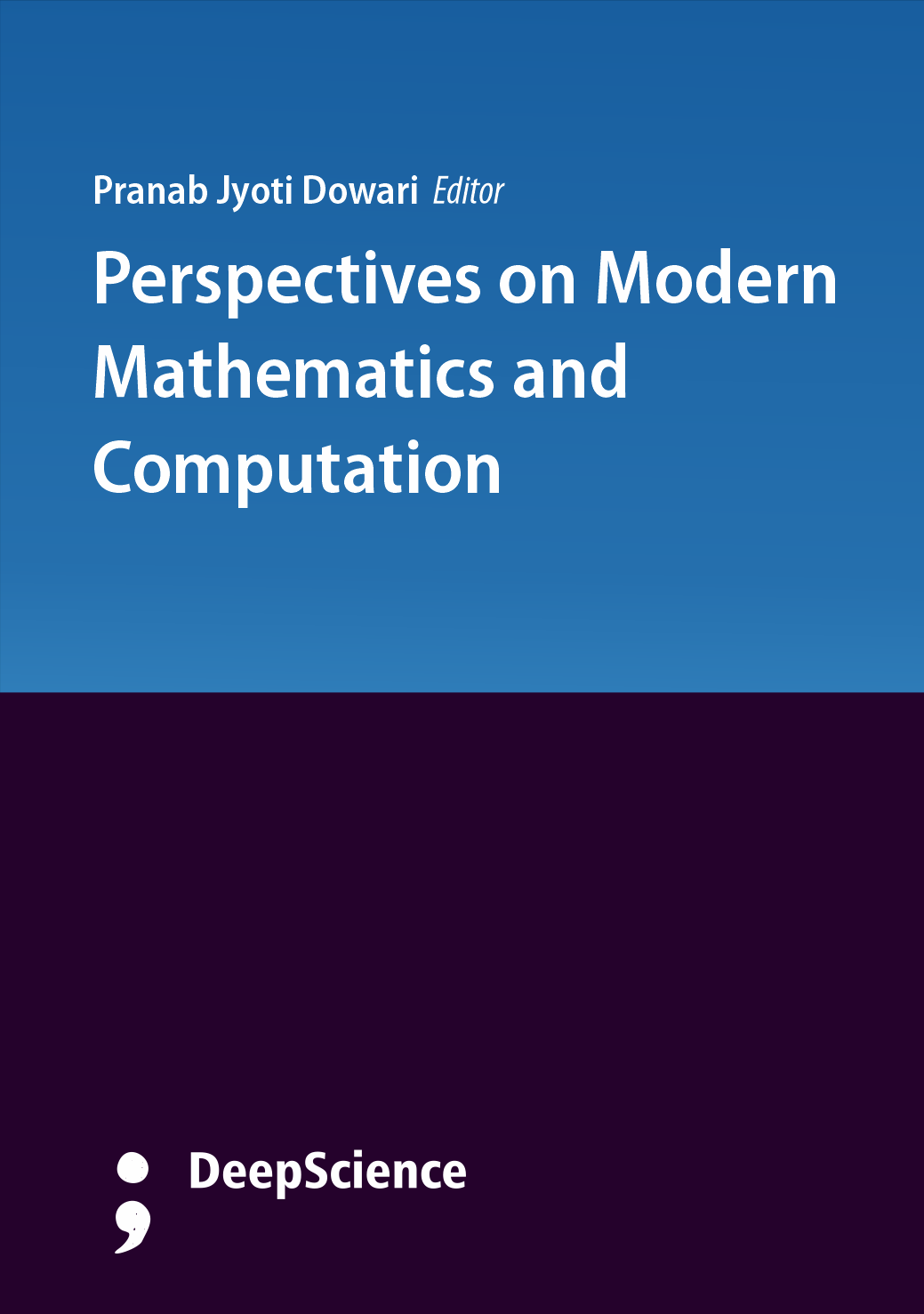
Perspectives on Modern Mathematics and Computation
##plugins.pubIds.doi.readerDisplayName##
https://doi.org/10.70593/978-93-7185-898-4
Keywords:
Mathematics, Computation, Bounded Variation, Integral Equations, Stability Analysis, MaterialsSynopsis
The current volume is a collection of fifteen research articles in widely but essentially related fields of mathematics, applied mathematics and theoretical physics. The book tries to assemble the progress in the various fields featuring both the theoretical growth and practical studies conducted by scholars in various organisations. The different chapters add to a different approach which has added more academic flavour to the entire story of the book.
In chapter 1, the authors give the definition of the concept of bounded variation of complex uncertain sequences. Extending the classical sequence analysis to an area, the uncertainty theory, in the context of which the measures of believes are used instead of probability measures, the chapter examines some underlying properties and convergence behaviours that extend the current analysis of uncertainty.
The chapter 2 revolves around the fixed-point theorems of partial modular metric spaces that are based on C-class functions. The authors come up with a number of new findings and demonstrate their relevance to nonlinear Volterra integral equations, and the significance of modular structures in nonlinear analysis.
Chapter 3 gives research on the entropy generation, in the magnetohydrodynamic dusty fluid flow over a vertical stretching sheet. The chapter is based on the advanced numerical and analytic tools which are used to examine the problems of heat transfer, fluid dynamics, and energy optimization through the introduction of changeable physical properties.
Chapter 4 studies lacunary almost convergence in the context of complicated uncertain sequences. Lacunary sequence theory and uncertainty modelling have been merged in this chapter giving the inclusion outcomes, structures, and convergence criteria to functional space, sequence space.
In chapter 5, the authors switch their focus to the study of astrophysics where turbulent astroclouds are considered in terms of their stability under the effect of tidal forces. The article is a combination of mathematical modelling and astrophysics to explore how interstellar matter forms, behaves, and is dynamically stable.
In Chapter 6, spectral properties of positive linear operators in the situation of relatively uniform convergence with respect to Orlicz functions are discussed. The chapter is a contribution to operator theory because it has developed novel relationships between positivity and boundedness as well as spectral behaviour in Orlicz settings.
In Chapter 7, the authors research the operators in the space of weakly statistically convergent sequences. The authors determine characterizations and preservation outcomes of interest to the theory of sequence spaces and summability by analysing operator transformations.
In chapter 8 a detailed study of thermal irreversibility and thermal dual solutions of Casson nanofluid flow over an expanding sheet is given. The effect of Lorentz force and chemical reactions is considered with the help of the detailed analysis of the stability with the support of the computational modelling.
Chapter 9 discusses the mass parameters of the neutrons respectively by taking a mass matrix with texture-zero structures. This chapter uses symbolic computations to research the field of particle physics with the use of Mathematica, studying possible neutrino masses models that can be valid based on experimental evidence.
In chapter 10, contemporary methods of computation are introduced in materials research. This chapter has revealed more sophisticated simulation techniques, algorithmic models and computer programs that are critical in the interpretation of material properties at both the microscopic and macroscopic level.
Chapter 11 presents the discussion of gravitational baryogenesis in a f(R) gravity theory that is modified. With the help of analytical modelling, the authors consider the ways in which a change of gravity theory can be used in contributing towards explanations of the matter-antimatter arsenities that are observable in the universe.
In chapter 12, the authors cover the topic of the paranormal polynomially-polar functional calculus of polynomially-paranormal operators and universal products. This chapter brings operator theory to a deeper level since a number of new findings were presented about operator classes, tensor relations, and functional analytic methods.
Chapter 13 explores the subject of Fermat numbers and generalized Fermat numbers. The authors show the structural properties, factorization behaviour, and number-theoretic patterns as part of the current research in the classical and computational number theory.
In Chapter 14, the free convective flow in a porous vertical plate with the inclusion of the effect of Dufour and chemical reactions is examined. The derivation and visualization of solutions that are of heat transfer and porous-medium flows is done through the use of a MATLAB-based approach.
In Chapter 15, it is proposed that the geometry of weak convergence of sequences of functions is introduced. A number of topological and geometrical characteristics are examined there.
Throughout these fifteen chapters, theoretical understanding, calculation, and operational models are incorporated in the book, and the reader gets the overall picture of research tendencies. The book will find value among the postgraduate students, researchers, and practitioners in the fields of mathematics, physics, engineering, and so on. The editors wish that the contributions contained herein would not only arouse further investigations but also serve as a source of inspiration of new avenues of research.
Chapters
-
Bounded Variation of Complex Uncertain Sequences
-
Fixed Point Theorems in Partial Modular Metric spaces with C-Class Function and Application to Non-linear Volterra Integral Equations
-
Analysis of Entropy Generation in MHD Dusty Fluid Flow along a Vertical Stretching Sheet with Variable Physical Properties
-
Lacunary Almost Convergence of Complex Uncertain Sequences
-
Stability Analysis of Turbulent Astrocloud in the Presence of Tidal force
-
Spectral Properties of Positive Linear Operators under Relatively Uniform Convergence with Respect to Orlicz Function
-
Operators on Weak Statistical Convergence of Sequences
-
Analysis of Thermal Irreversibility and Dual solutions of Casson Nanofluid flow over an Expanding Sheet under the Influence of Lorentz force and Chemical Reaction: A Stability Examination
-
Study of neutrino parameters from texture zero in the neutrino mass matrix using Mathematica
-
Modern Computational Techniques for Materials Research
-
Analytical Study of Gravitational Baryogenesis within a selected Modified f(R) Gravity Model
-
Tensor Products and Functional Calculus of Polynomially Paranormal Operators
-
A study of Fermat Numbers and Generalized Fermat numbers
-
Free convective flow through a porous vertical plate in a porous medium with Dufour effect and chemical reaction: A MATLAB-Based Numerical Study
-
Weak Convergence of Sequences of Functions
References
Moreira DR, Teixeira EV. Weak convergence under nonlinearities. Anais da Academia Brasileira de Ciências. 2003;75:9-19.
Ferreira MA, Andrade M, Filipe JA. Weak convergence in Hilbert spaces. International Journal of Academic Research. 2012 Jul 1;4(4):34-6.
Narita K, Shidama Y, Endou N. Weak Convergence and Weak Convergence. Formaliz. Math.. 2015 Sep 1;23(3):231-41.
Kim BY. Weak-and strong convergence in space of linear operators. The Mathematical Education. 1975 Jan;14(1):19-21.
Connor J, Ganichev M, Kadets V. A characterization of Banach spaces with separable duals via weak statistical convergence. Journal of Mathematical Analysis and Applications. 2000 Apr 1;244(1):251-61.
Downloads
Published
16 September 2025
Copyright (c) 2025 Pranab Jyoti Dowari; Dilip Saikia, Kalyan Malakar, Tapan Kumar Chutia, Santana Hazarika, Kalyan Chamuah Chamuah, Dilip Kumar Baruah, Sujata Saikia Saikia, Niki Gogoi, Happy Borgohain, Rupjyoti Borah, Binod Chandra Tripathy, Dipankar Das, Liza Hazarika Hazarika, Jadav Konch, Sukanta Paul, Pranamika Dutta, Munindra Regon, Ibha Rani Borsaikia, Rajdeep Mazumdar
Details about the available publication format: E-Book
E-Book
ISBN-13 (15)
978-93-7185-898-4
Details about the available publication format: Book (Paperback)
Book (Paperback)
ISBN-13 (15)
978-93-7185-734-5
How to Cite
Dowari, P. J. (Ed.). (2025). Perspectives on Modern Mathematics and Computation. Deep Science Publishing. https://doi.org/10.70593/978-93-7185-898-4
Download Citation








 WhatsApp +91 7977171947