

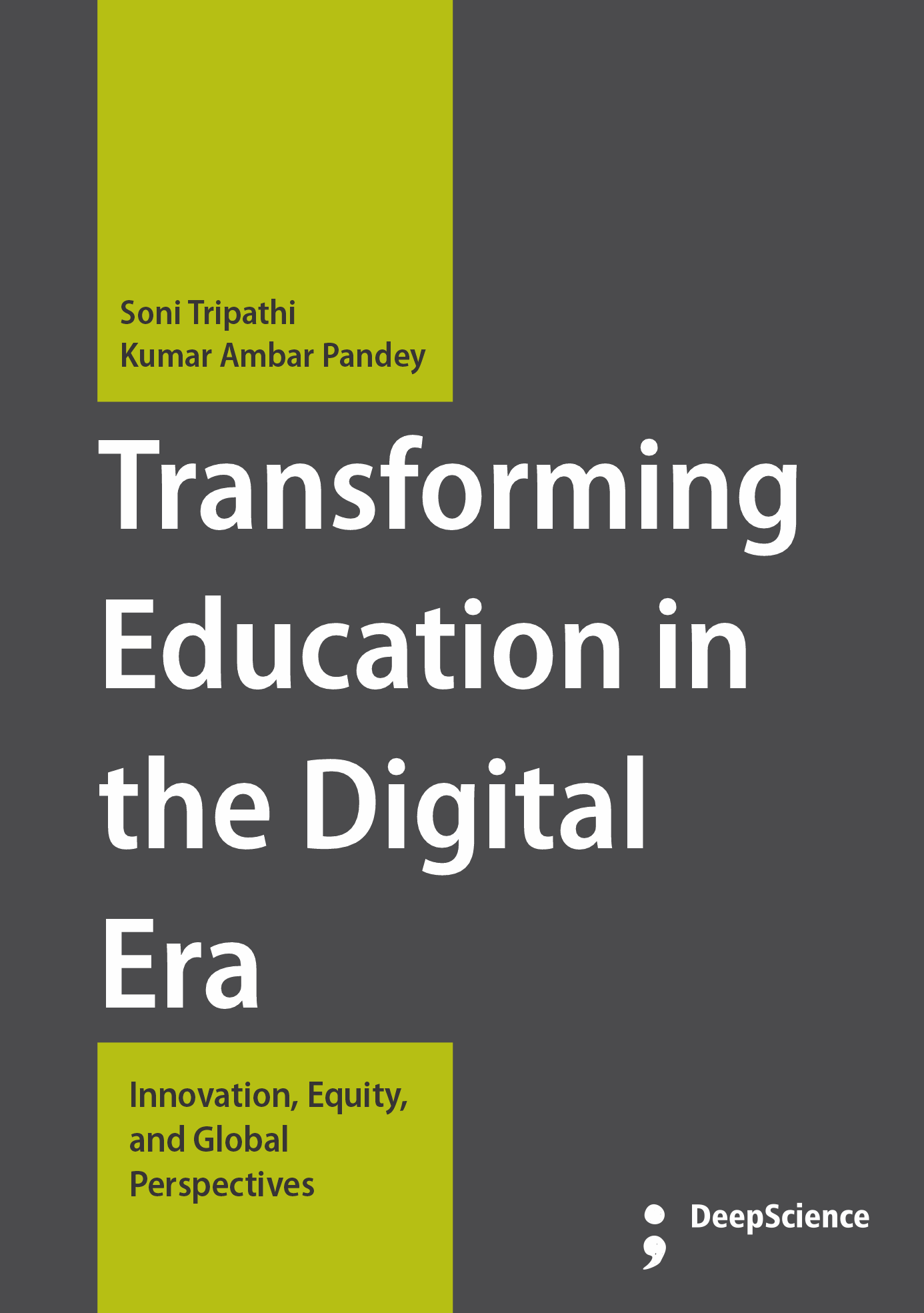
Transforming Education in the Digital Era: Innovation, Equity, and Global Perspectives
##plugins.pubIds.doi.readerDisplayName##
https://doi.org/10.70593/978-93-7185-103-9
Keywords:
Education, Artificial Intelligence, Waste Management, Gamification, Virtual Reality, Augmented Reality, Blended LearningSynopsis
The digital revolution has had a major impact on the education field the repercussion of the revolution is influencing the learning, teaching and access to information. The shift of learning models due to technological advancement, globalization, and varying learner demands continues to change the traditional practices, although to a large extent, it is broadening classroom physical and conceptual boundaries. Damagingly, institutions, educators, everybody is re-inventing the manner we treat the knowledge procedure. Transforming Education in the Digital Era: Innovation, Equity, and Global Perspectives provide diverse access points that will illuminate this evolution, the new opportunities that will enable us to successfully create relevant, inclusive and forward-oriented learning environments.
Chapters of this book provides a very extensive and well-structured overview of the most topical spheres of research and development in the sphere of digital education. These consist of the recent tendencies in digital pedagogy, artificial intelligence, VR and AR, learning analytics, and learning in the form of a game, which are reviewed in terms of a theoretical and a practical perspective. The professional development of teachers, open educational materials, cybersecurity, and digital policy guidelines are also given the appropriate consideration that expands the range of the discussion on the use of technology and digital access (although they are the key aspects of the issue, of course) to include the human, ethical and systemic aspects of the educational processes revolution aspects.
Social equality and accessibility are two themes of this book. Technology can be used to increase the learning opportunities but this can be only done with special care, implementation, professional infrastructure and support. This book has challenged the reader to reflect critically on how application of technology world-wide and within these diverse facets can make more opportunities, access and fair participation in learning.
We hope that the book will become an effective resource to the teachers, scholars, policymakers, and students in order to impact the course of educational policies and practices. It is our hope that this will encourage all the stakeholders to hold productive discussions, to make wise decisions, and work towards having strategies that will help one to evolve, develop, and thrive in the changing global environment.
References
Adair, A. (2023). Teaching and learning with AI: How artificial intelligence is transforming the future of education. Dl.Acm.Org, 29(3), 7–9. https://doi.org/10.1145/3589252
Akgun, S., & Greenhow, C. (2022). Artificial intelligence in education: Addressing ethical challenges in K-12 settings. AI and Ethics, 2, 431–440. https://doi.org/10.1007/s43681-021-00096-7
Ali, O., Murray, P. A., Momin, M., Dwivedi, Y. K., & Malik, T. (2024). The effects of artificial intelligence applications in educational settings: Challenges and strategies. Technological Forecasting and Social Change, 199, 123076. https://doi.org/10.1016/j.techfore.2023.123076
Grassini, S. (2023). Shaping the future of education: Exploring the potential and consequences of AI and ChatGPT in educational settings. Mdpi.Com, 13(7), 692. https://doi.org/10.3390/educsci13070692
Hwang, G.-J., Xie, H., Wah, B. W., &Gašević, D. (2020). Vision, challenges, roles and research issues of Artificial Intelligence in Education. Computers and Education: Artificial Intelligence, 1. https://doi.org/https://doi.org/10.1016/j.caeai.2020.100001
Downloads
Published
12 December 2025
Copyright (c) 2025 Soni Tripathi, Kumar Ambar Pandey
Details about the available publication format: E-Book
E-Book
ISBN-13 (15)
978-93-7185-103-9
Details about the available publication format: Book (Paperback)
Book (Paperback)
ISBN-13 (15)
978-93-7185-826-7
How to Cite
Tripathi, S. ., & Pandey, K. A. . (Eds.). (2025). Transforming Education in the Digital Era: Innovation, Equity, and Global Perspectives. Deep Science Publishing. https://doi.org/10.70593/978-93-7185-103-9
Download Citation







 WhatsApp +91 7977171947