
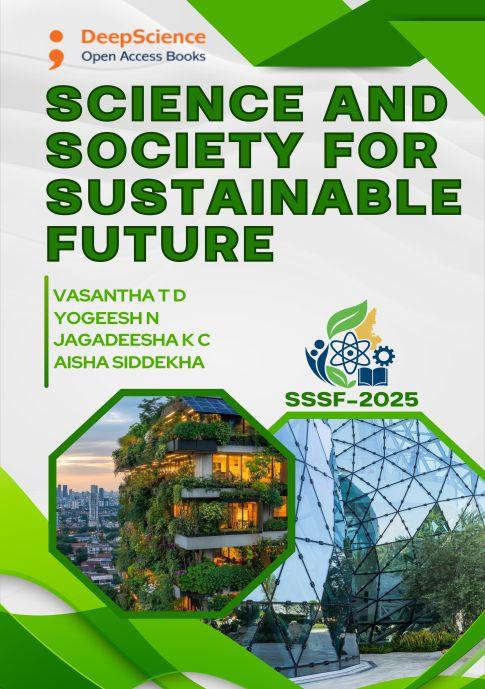
Science and Society for Sustainable Future
##plugins.pubIds.doi.readerDisplayName##
https://doi.org/10.70593/978-93-7185-615-7
Keywords:
Sustainable Development, Sustainable Development Goals, FinTech, Data Privacy, Supply Chain, Explainable Artificial IntelligenceSynopsis
We are delighted to present this edited volume of twenty-six selected chapters from the One-Day National Conference Science & Society for Sustainable Future (SSSF-2025), hosted by the Department of Science, Government First Grade College, Tumkur, in association with the Karnataka Science & Technology Academy (KSTA), Department of Science & Technology, Government of Karnataka. The contributions reflect a shared commitment to ensuring that rigorous, ethical, and inclusive science advances tangible societal outcomes across education, health, environment, energy, economy, governance, and culture.
The chapters span physical and life sciences; green chemistry and environmental studies; mathematics, biomathematics, statistics and computing; engineering and technology; nursing and medical sciences; commerce, management and ESG; humanities, social sciences and education; media and communication; library and information science; and physical education and well-being. Several papers also showcase interdisciplinary methods, community-linked case studies, and underscoring the conference vision of science translated for local relevance and global significance.
Our editorial approach emphasized clarity, integrity, and reproducibility. Authors were encouraged to present concise problem statements, methods, results, and limitations; to adhere to ethical norms on similarity, permissions, human/animal approvals where applicable; and to disclose any use of AI assistance transparently. Where feasible, contributors provided pointers to datasets, code, protocols, or justified availability statements to enable verification and reuse. Each chapter underwent screening and review for technical soundness, relevance to the theme, and the potential to inform practice and policy.
We gratefully acknowledge KSTA for its sustained support to Karnataka’s science ecosystem; our International and National Advisory Boards, reviewers, session chairs, and the Organising Committee for their meticulous efforts; and our student volunteers for tireless on-ground coordination. Above all, we thank the authors for trusting this platform and contributing work that is both methodologically robust and socially meaningful.
We hope this book serves researchers, teachers, students, practitioners, and policy actors as a compact guide to emerging ideas and collaborations-sparking classroom innovations, field pilots, and partnerships that carry science confidently into society and toward a sustainable future.
References
Patil, S. S. (2024). Impact of Lending Practices on the Adoption of Green Banking Practices for the Sustainable Development. Royal International Global Journal of Advance and Applied Research 1(1), 1–5.
Chitra, V., & Gokilavani, R. (2020). Green Banking trends: Customer knowledge and awareness in India. Shanlax International Journal of Management, 8(01), 54-60.
Neeraja and Raji Joseph (2021), Green Initiatives of SBI: A Customer – Centric Study, EPRA International Journal of Economic and Business Review-Peer Reviewed Journal,9 (4), 14 – 19.
Jaggi, G. (2012). Green Banking: Initiatives by SBI and ICICI. Paripex - Indian Journal Of Research, 3(6), 121-122.
Nayana N Nair, Dr. S. Rajendran, (2024), A New Model On Consumer Behaviour For Green Banking Practices, Educational Administration: Theory and Practice, 30(4), 2267 - 2287,
Kaur, K., & Sandhu, V. (2019). Green Initiatives in Banking Sector: A study of state bank of India (SBI). ZENITH International Journal of Multidisciplinary Research, 9(7), 111-120.
Gopi, S., (2016). A Study on The Impact of Green Banking in Environmental Protection. International Journal of Advance Research and Innovative Ideas in Education. 1(4), 382 388.
Downloads
Published
30 November 2025
Copyright (c) 2025 Vasantha T D, Yogeesh N, K C Jagadeesha; Aisha Siddekha
Details about the available publication format: E-Book
E-Book
ISBN-13 (15)
978-93-7185-615-7
Details about the available publication format: Book (Paperback)
Book (Paperback)
ISBN-13 (15)
978-93-7185-229-6
How to Cite
Vasantha T D, Yogeesh N, & K C Jagadeesha (Eds.). (2025). Science and Society for Sustainable Future. Deep Science Publishing. https://doi.org/10.70593/978-93-7185-615-7
Download Citation





 WhatsApp +91 7977171947