

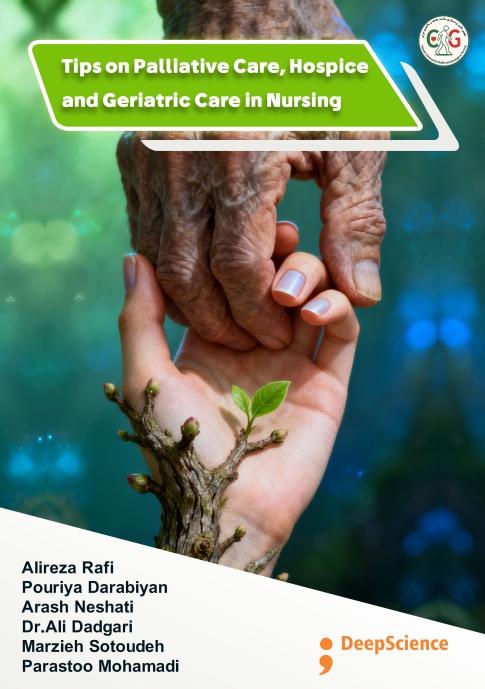
Tips on Palliative Care, Hospice and Geriatric Care in Nursing
##plugins.pubIds.doi.readerDisplayName##
https://doi.org/10.70593/978-93-7185-841-0
Keywords:
Palliative Care, Geriatric Care, Nursing, Hospice Care, Pain Assessment, Cancer Care, Heart DiseasesSynopsis
In recent years, with the help of social and economic development and advances in the health system, it has achieved a higher average age and a longer life expectancy. In addition to its positive aspects, old age is accompanied by various problems that include physical, mental, social and spiritual aspects and are accompanied by imposing significant costs. The inevitable changes of this period, as natural changes in the body, can affect the elderly and their families. On the other hand, maintaining the health and well-being of the elderly is a possible thing that is realized with the wisdom of geriatric nurses. Efforts to maintain and improve the health of the elderly include the initial levels of prevention to disability, which nurse practitioners can be very effective in combining specialized nursing knowledge and skills with decision-making and communication skills, problem solving and diagnostic skills.
Due to the increase in life expectancy and exposure to chronic diseases, the need for long-term care has increased. On the other hand, the progress of medical and nursing care in end-of-life care has led nursing sciences to focus specifically on hospice care. Today, hospice care is considered one of the important topics in end-of-life nursing care, and a nurse who enters this field needs special knowledge and awareness in order to be able to provide comprehensive care based on current science as an expert and professional. Therefore, access to reliable, concise, and up-to-date resources is of utmost importance for these specialists.
Palliative care services, along with the concepts of health promotion, prevention, treatment, and rehabilitation, are considered the fifth axis in accessing universal health coverage, and therefore, in order to ensure equitable access of people to timely, affordable, and high-quality services, the development of these services is considered a necessity. The efforts made in the past decade in this area, while raising awareness among health service providers and the community about the necessity of these services, have also explained the importance of the issue to policymakers, such that significant progress in various areas of palliative care services in the country is observed in the World Health Organization's 2025 report. However, this area of care still requires additional efforts and addressing various and sometimes neglected dimensions of palliative care, one of which seems to be end-of-life care and hospice services, which, for various reasons, especially social and cultural challenges, has not grown at a pace commensurate with other dimensions. This is despite the fact that today the concept of "good death" has become one of the most important keywords in this category, and therefore addressing it is recommended to pay as much attention to "quality of life".
It is hoped that writing this book will take a small step towards improving the health of the elderly and the quality of palliative care.
References
Caissie, A. & Zimmermann, C. (2017). Communication skills for end-of-life care. In S. J. McKean, J. J. Ross, D. D. Dressier, & D. B. Scheurer (Eds.), Principles and Practice of Hospital Medicine (pp. 1733-1739). McGraw Hill Education.
Chulk, P. (2008). Clinical nurse specialists and quality patient care. Journal of Advanced Nursing, 26, 501–506.doi:10.1046/j.1365-2648.1997.t01-9-00999.x
Coyle, N. (2015). Introduction to palliative care. In B. R. Ferrell, N. Coyle, & J. A. Paice (Eds.), Oxford textbook of palliative nursing (pp. 3–19). New York, NY: Oxford University Press.
Coyne, P. J. (2003). The evolution of the advanced practice nurse within palliative care. Journal of Palliative Medicine, 6(5), 769–770. doi:10.1089/109662103322515275
Dahlin, C. M., & Wittenberg, E. (2019). Communication in palliative care: An essential competency for nurses. In B. R. Ferrell & J. A. Paice (Eds.), Oxford textbook of palliative nursing (5th ed., pp. 55–78). New York, NY: Oxford University Press.
De Lima, L., & Pastrana, T. (2016). Opportunities for palliative care in public health. Annual Review of Public Health, 37, 357–374. doi:10.1146/annurev-publhealth-032315-021448
Dy, S. M., Lupu, D., & Seow, H. (2012). Progress towards systems of quality measurement that capture the essence of good palliative care. Palliative Medicine, 26(4), 291–293. doi:10.1177/0269216312444796
El-Jawahri, A., Traeger, L., Shin, J. A., Knight, H., Mirabeau-Beale, K., Fishbein, J., . . . Temel, J. S. (2017). Qualitative study of patients’ and caregivers’ perceptions and information preferences about hospice. Journal of Palliative Medicine, 20(7), 759–766. doi:10.1089/jpm.2016.0104
Faull, C. (2012). Context and principles of palliative care. In C. Faull, S. de Caestecker, A. Nicholson, & F. Black (Eds), The handbook of palliative care (3rd ed.). London, England: Wiley Blackwell.
Ferrell, B. R. (2019). Introduction to palliative care. In B. R. Ferrell & J. A. Paice (Eds.), Oxford textbook of palliative nursing (5th ed., pp. 34). New York, NY: Oxford University Press
Ferrell, B. R., Coyle, N., & Paice, J. A. (2015). Oxford textbook of palliative nursing (4th ed.). Oxford, England: Oxford University Press.
Downloads
Published
28 November 2025
Copyright (c) 2025 Kourosh Zarea, Alireza Rafi, Pouriya Darabiyan, Arash Neshati, Ali Dadgari, Marzieh Sotoudeh, Parastoo Mohamadi
Details about the available publication format: E-Book
E-Book
ISBN-13 (15)
978-93-7185-841-0
Details about the available publication format: Book (Paperback)
Book (Paperback)
ISBN-13 (15)
978-93-7185-584-6
How to Cite
Zarea, K. ., Rafi, A. ., Darabiyan, P. ., Neshati, A. ., Dadgari, A. ., Sotoudeh, M. ., & Mohamadi, P. . (2025). Tips on Palliative Care, Hospice and Geriatric Care in Nursing. Deep Science Publishing. https://doi.org/10.70593/978-93-7185-841-0
Download Citation










 WhatsApp +91 7977171947