

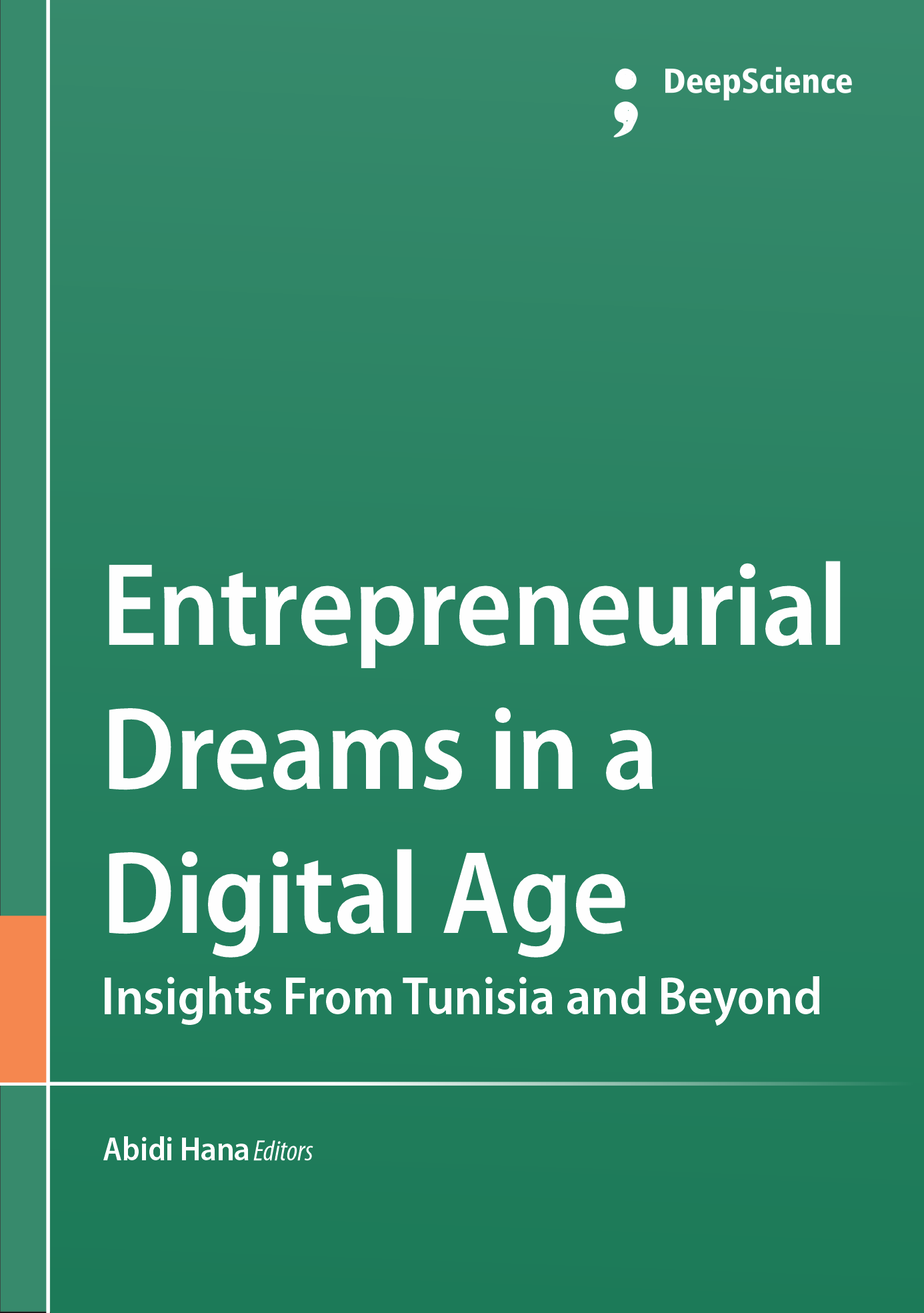
Entrepreneurial Dreams in a Digital Age: Insights From Tunisia and Beyond
##plugins.pubIds.doi.readerDisplayName##
https://doi.org/10.70593/978-93-7185-108-4
Keywords:
Digital Entrepreneurship , Artificial Neural Networks, Social Capital, Organizational Performance, Social Enterprises, TourismSynopsis
This book discusses the nature of transformation of entrepreneurship in digital age with the focus on Tunisia and other emerging contexts. It investigates the impacts of innovation, social networks and digital transformation on the organizational performance, intentions, and entrepreneurship. The first chapter uses artificial neural networks to model the complex interactions within Tunisian companies to determine how both the internal and external board social capital are related to social and economic success.. The second chapter explores smart hotels as intelligent tourism entrepreneurship, examining visitor attitudes and emphasizing how creative hospitality techniques and technology solutions support new business models in the travel industry. The third chapter highlights the influence of subjective norms on customer behavior in digital marketing environments by examining how visual advertising inventiveness affects cognitive reactions and purchase intention. This book offers a thorough understanding of how entrepreneurial ambitions are formed, nurtured, and realized in a digitally connected world by fusing empirical data, quantitative modeling, and insights from digital innovation. For academics, corporate executives, and legislators looking to promote innovation-driven entrepreneurship in Tunisia and elsewhere, it provides useful insights.
References
Austin, J., Stevenson, H. and Wei-Skillern, J. (2006). Social and commercial entrepreneurship: same, different or both? Entrepreneurship, Theory and Practice, 30, pp.122.
Bacq, S. and Alt, E. (2018), “Feeling capable and valued: a prosocial perspective on the link between empathy and social entrepreneurial intentions”, Journal of Business Venturing, Vol. 33 No. 3, pp. 333-350.
Barroso-Castro, C., Villegas-Periñan, M. del M., & Casillas-Bueno, J. C. (2016). How boards’ internal and external social capital interact to affect firm performance. Strategic Organization, 14(1), 6–31.
Battilana, J. and Lee, M. (2014). 'Advancing Research on Hybrid Organizing - Insights from the Study of Social Enterprises'. Academy of Management Annals, 8, 397-441.
Bechir Fridhi ,Social entrepreneurship and social enterprise phenomenon: toward a collective approach to social innovation in Tunisia, Journal of Innovation and Entrepreneurship (2021).
Benedic, M., Valoggia, P., Rousseau, A. et C. Schmitt, C. (2009), Gestion des connaissances et capital social : quelles interrelations? Revue Management & Avenir, 27, 152-170.
Bennett, R. and Savani, S. (2011). 'Surviving mission drift: How charities can turn dependence on government contract funding to their own advantage'. Nonprofit Management and Leadership, 22, 217-231.
Downloads
Published
15 November 2025
Copyright (c) 2025 Abidi Hana
Details about the available publication format: E-Book
E-Book
ISBN-13 (15)
978-93-7185-108-4
Details about the available publication format: Book (Paperback)
Book (Paperback)
ISBN-13 (15)
978-93-7185-355-2
How to Cite
Hana, A. . (2025). Entrepreneurial Dreams in a Digital Age: Insights From Tunisia and Beyond. Deep Science Publishing. https://doi.org/10.70593/978-93-7185-108-4
Download Citation








 WhatsApp +91 7977171947