
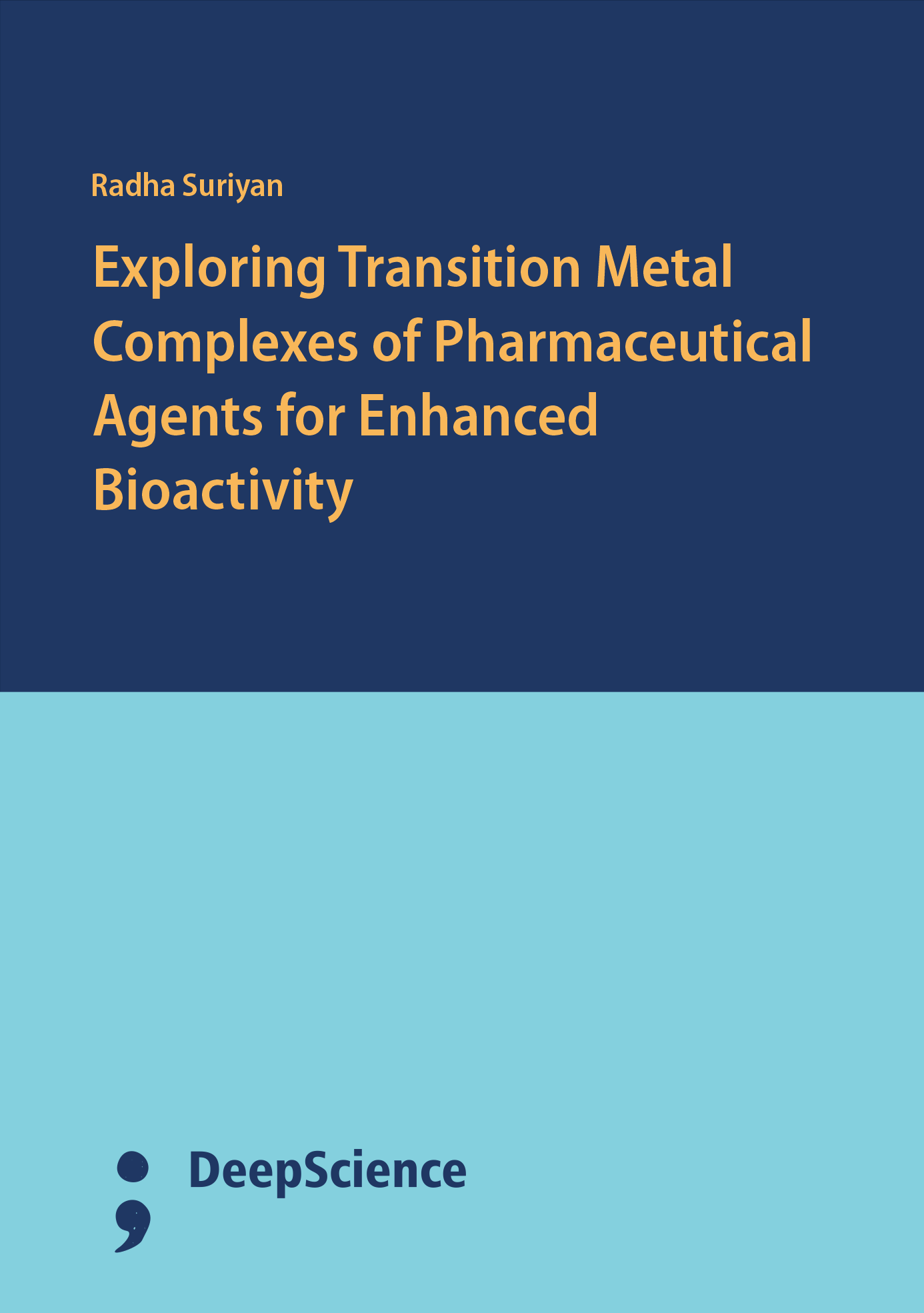
Exploring Transition Metal Complexes of Pharmaceutical Agents for Enhanced Bioactivity
##plugins.pubIds.doi.readerDisplayName##
https://doi.org/10.70593/978-93-7185-576-1
Keywords:
Transition metal complexes, Coordination chemistry, Bioinorganic chemistry, Metal drug complexes, Organometallic chemistry, Chelation therapySynopsis
The book is a thorough overview of how coordination chemistry can make the existing therapeutic drugs have the potential to transform. Having complexes with transition metals, most pharmaceutical agents display greater stability, greater bioavailability, and potent bioactivity, thus opening new potential of drugs development and targeted therapy.
The book has combined the basic concepts, current research developments and applications in a reachable manner to give the students, researchers and practitioners a clear picture of the symbiotic correlation that exists between metal ions and medicines. It throws light through the elaborate discussions on how metal-drug complexes are able to solve various problems that include resistance, toxicity and low solubility.
I wish that this work will result in further researches in the field that is rapidly developing, and has a contribution to the creation of more effective and safer therapeutic approaches.
I highly appreciate everyone who has helped to do this book successfully with support, skill, and guidance and I am grateful to all these people. It is an outcome of various inspirations, interaction, and unremitting encouragement of numerous people and establishments.
References
British Pharmacopoeia-II, Biological assay and Tests; the Stationary Office Ltd: London, 1998, 205.
Sanmartin. J.; Bermejr, M. R.; Garcia-Deibe, A. M. Inorg. Chim. Acta. 2008, 318.
Nakamoto, K. Infrared and Raman Spectra of Inorganic and Coordination Compounds. Part B. 5; John Wiley and Sons: New York, 1997.
Nelwamondoa, A. N.; Eveb, D. J.; Watkinsb, G. M.; Brown, M. E. Thermochim. Acta. 1998, 318, 165.
Carmo, A. M. L.; Silva, F. M. C.; Machado, P. A.; Fontes, A. P. S.; Pavan, F. R.; Leite, C. Q. F.; Leite, S. R. De A.; Coimbra, E.S.; Da Silva, A. D. Biom. Pharm. 2011, 65(3), 204.
Equardo, H. S. S.; Luiz, A. B.; Diogenes, S. S.; Izaura, C. N. D.; Elisane, L.; Luiz, G. F. L.; Icaro de Sousa, M. J. Bio Inorg. Chem. 2012, 17, 275.
Haines, R. I.; Hutching, D. R.; McCormack, T. M. J. Inorg. Biochem. 2001, 85, 1.
Shazia, R.; Muhammed, I.; Nasim, A.; Haji, A.; Amin, A. Biotechnol. Mol. Bio. Rev. 2010, 5, 38.
Wana, A. A. J. Chem. Pharm. Res, 2011, 3, 951.
Oliveira, J. S.; Sousa, E. H. S.; Basso, L. A.; Palaci, M.; Dietze, R.; Santos, D. S.; Moreira I. S. Chem. Commun. 2004, 3, 312.
Jesudurai, D.; Vancheesan, S. Ind. J. Chem. Sec. A. 2003, 42A, 1609.
Yang, P.; Zhang. X, J. Mol. Sci. 1990, 6, 99.
Kremer, E.; Facchin, G.; Estevez, E.; Albores, P.; Baran, E. J.; Torre M. T. J. Inorg. Biochem. 2006, 100, 1167.
Lin Vien, D.; Colthup, N. B.; Fateley, W. G.; Grasselli, J. G. The Handbook of Infrared and Raman Characteristic Frequencies of Organic Molecules; Academic Press inc: Boston, 1991.
Nelwamondoa, A.N.; Eveb, D.J.; Watkinsb, G.M.; Brown, M.E. Thermochim. Acta. 1998, 318, 165-175.
Downloads
Published
24 November 2025
Copyright (c) 2025 Radha Suriyan
Details about the available publication format: E-Book
E-Book
ISBN-13 (15)
978-93-7185-576-1
Details about the available publication format: Book (Paperback)
Book (Paperback)
ISBN-13 (15)
978-93-7185-428-3
How to Cite
Suriyan , R. . (2025). Exploring Transition Metal Complexes of Pharmaceutical Agents for Enhanced Bioactivity. Deep Science Publishing. https://doi.org/10.70593/978-93-7185-576-1
Download Citation





 WhatsApp +91 7977171947