

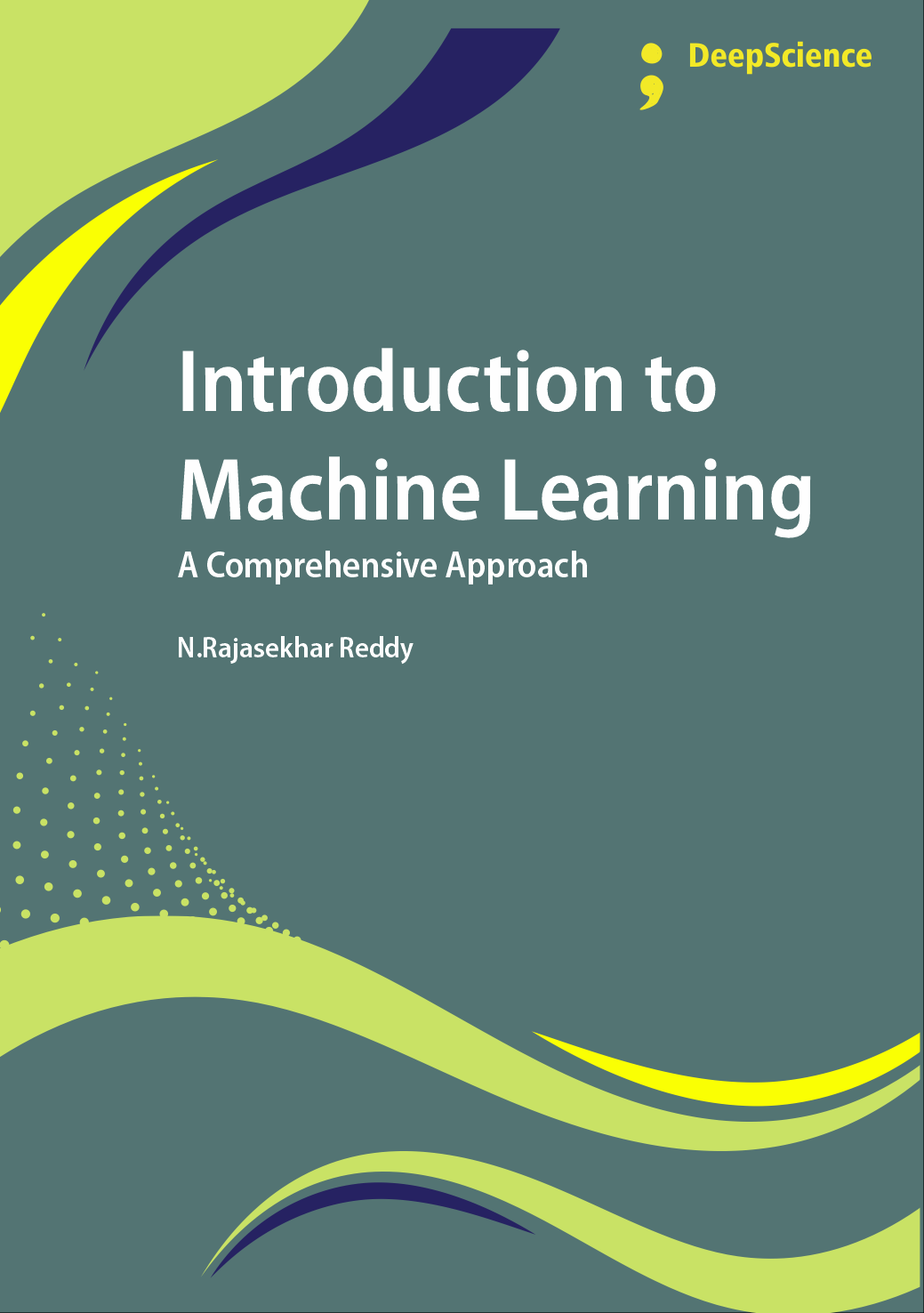
Introduction to Machine Learning: A Comprehensive Approach
##plugins.pubIds.doi.readerDisplayName##
https://doi.org/10.70593/978-93-7185-302-6
Keywords:
Machine Learning, Artificial Intelligence, Threats, Security, DNS Attacks, CrimeSynopsis
The past ten years have witnessed a massive increase in the number of users of machine learning. The users of machine learning now can be found in the departments of computer science, engineering and mathematics, and they are no longer limited to a comparatively small circle, but encompass the students and researchers in the far right corners of the academic realm using machine learning as well as the members of industry, data scientists, entrepreneurs and machine learning enthusiasts. The book itself is the outcome of a total deconstruction of the usual curriculum of the machine learning into its simplest units, and a doping selection of those fragments, which we believe will be of the greatest service to this expanding group of students. It is full of fresh and easily comprehensible yet strict accounts of the most basic concepts, which one requires to do research, design products, fiddle and play.
It is a book that is targeted at people who are interested in learning the foundations of the machine learning in the first principles up to the application that they can use. The simplest knowledge of the text requires a rudimentary familiarity with linear algebra and calculus (i.e., how to manipulate vectors and matrices and how to calculate the gradient and Hessian of a multivariate), and some familiarity with the fundamentals of computer programming (i.e., conditional and iterative formations). It was composed not only to instruct first time students in the subject, but also to provide the more learned reader longing to be served with something less complicated and complex such as is present in modern times, which he or she may desire.
In this direction, at several points in the text, when outlining the principles of each concept, we prefer the applications of not probabilistic, statistical, and neurological points of view of the material, but to a new and uniform geometry. As we think, not only does it allow one to form more intuitively a variety of fundamental concepts, but it assists in revealing fascinating correlations between the concepts widely considered to be diametrically opposite (such as the logistic regression and the support vector machine classifier, kernels, and feed-forward neural networks). We also put substantial emphasis in the design and implementation of algorithms, and provide the reader with numerous coding exercises at the end of every chapter. This is so since we highly feel that the major part of learning this subject comes when the learners get their hands dirty and write up things themselves.
References
ATE Centers and National Science Foundation. (n.d.). ATE Programs and Overview. Retrieved from http://www.atecenters.org/wp-content/uploads/2016/07/ATE_Overview_2016.pdf AUSTRALIA’S CYBER SECURITY STRATEGY Enabling innovation, growth & prosperity [PDF]. (n.d.). Retrieved from https://cybersecuritystrategy.pmc.gov.au/assets/img/PMC-Cyber-Strategy.pdf
Bessen, J. (2014, August 25). Employers Aren’t Just Whining – the “Skills Gap” is Real. Harvard Business Review. Retrieved from https://hbr.org/2014/08/employers-arent-just-whining-the-skills-gap-is-real
Best in Class Strategies for Entry-Level Employee Retention Prepared for 100K [PDF]. (2016, October). FSG Reimagining Social Change. Retrieved from https://www.100kopportunities.org/2016/10/14/best-in-class-strategies-for-entry-level-employeeretention/
Best Places to Work for Cyber Ninjas. (2017, May). Retrieved from https://www.sans.org/best-places-to-work-for-cyber-ninjas?ref=195285
Bojanova, I., Vaulx, F., Zettsu, K., Simmon, E., Sowe, S. (2016, January 21). Cyber-Physical-Human Systems Putting People in the Loop. IT Professional. Retrieved from http://ieeexplore.ieee.org/document/7389271/
Canadian Apprenticeship Forum Forum Canadien Sur I’Apprentissage. (2009, June). It Pays to Hire an Apprentice: Calculating the Return on Training Investment for Skilled Trades Employers in Canada A Study of 16 Trades Phase II Final Report.
Downloads
Published
20 November 2025
Copyright (c) 2025 N.Rajasekhar Reddy
Details about the available publication format: E-Book
E-Book
ISBN-13 (15)
978-93-7185-302-6
Details about the available publication format: Book (Paperback)
Book (Paperback)
ISBN-13 (15)
978-93-7185-558-7
How to Cite
Reddy, N. . (2025). Introduction to Machine Learning: A Comprehensive Approach. Deep Science Publishing. https://doi.org/10.70593/978-93-7185-302-6
Download Citation







 WhatsApp +91 7977171947