

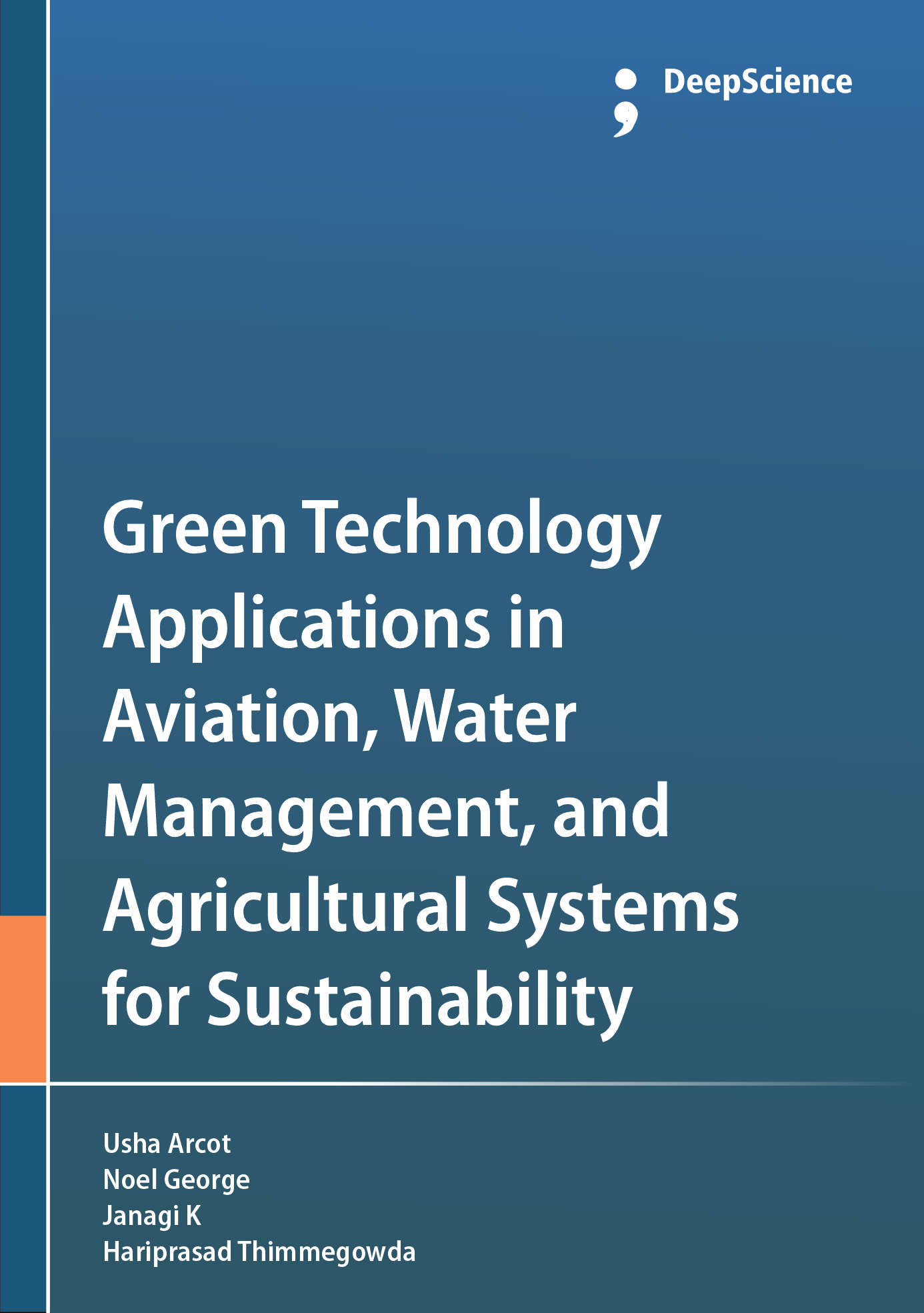
Green Technology Applications in Aviation, Water Management, and Agricultural Systems for Sustainability
##plugins.pubIds.doi.readerDisplayName##
https://doi.org/10.70593/978-93-7185-726-0
Keywords:
Green Technology, Environmental Sustainability, Renewable Energy, Smart Cities, Energy Efficiency, Green Internet of Things, Sustainable AgricultureSynopsis
The 21st century has been a critical turning point in which humanity is facing a turning point that will define the future of our planet for generations to come. With growing environmental disasters and intensified socio-economic inequality, the need to go sustainable and technologically solution-focused has never been more urgent. The genesis of this book is in an underlying belief that the sustainability issues are fundamentally intertwined, and it is a systemic problem involving energy, water, transportation, agriculture, and governance. Both are essential to the balanced state of the planet and are required to evolve using green technology and inclusive innovation. The following chapters consider these connections and utilise the scientific advances, policy frameworks, and practice to redefine responsible development in a continuously changing world.
Chapter one sets the conceptual pillars of green technology, which defines the scope of it and how it transforms in these areas of renewable energy, waste management, sustainable agriculture, and urban development. It is followed by a comprehensive analysis of sustainable aviation - an industry that represents both challenges in innovations and opportunities. This section addresses electric propulsion, sustainable aviation fuels, lightweight materials, and aerodynamic progress and shows how aviation can reconcile the connectivity of the world with environmental conservation.
The book then touches on water management, which is the basis of ecological and human systems. It explores new technologies such as smart monitoring, renewable-powered desalination, wastewater recycling, and nature-based solutions through green technology and demonstrates how these can guarantee water during the volatility of the climate. The final part also emphasises solutions-oriented research, which points to the importance of transdisciplinary collaboration, participatory engagement, and knowledge co-production to transform scientific knowledge into change in the real world. Fundamentally, this book is a call to action and an academic investigation. It compels the readers, who may happen to be scholars, policymakers, students, and practitioners, to go beyond academic compartments and embrace sustainability as a shared chore of moral and intellectual effort. The chapters aim to teach and inspire, and work towards a path of integrating technology, policy, and research to the place of resilience and equity in the future.
We express our deepest gratitude to the contributors and their knowledge and ingenuity, and effort that have shaped this volume and to Alliance University that has fostered a culture of innovation and cross-disciplinary inquiry. I also wish to appreciate the students and my colleagues whose questions and curiosity drive this continuous pursuit of the knowledge that is useful to man and to the planet as well. You shall find, as you go on the pages that follow, that there is accuracy in science mingled with the expectation of possibilities--another way is really a green future.
References
Albreem, M. A., El-Saleh, A. A., Isa, M., Salah, W., Jusoh, M., Azizan, M. M., & Ali, A. (2017, November). Green internet of things (IoT): An overview. 2017 IEEE 4th International Conference on Smart Instrumentation, Measurement and Application (ICSIMA) (pp. 1–6). IEEE.
Albreem, M. A., Sheikh, A. M., Alsharif, M. H., Jusoh, M., & Yasin, M. N. M. (2021). Green Internet of Things (GIoT): Applications, practices, awareness, and challenges. IEEE Access, 9, 38833–38858.
Almalki, F. A., Alsamhi, S. H., Sahal, R., Hassan, J., Hawbani, A., Rajput, N. S., Saif, A., Morgan, J., & Breslin, J. G. (2021). Green IoT for eco-friendly and sustainable smart cities: Future directions and opportunities. Mobile Networks and Applications, 28(1), 178–202. https://doi.org/10.1007/s11036-021-01790-w
Alsamhi, S. H., Ma, O., Ansari, M. S., & Meng, Q. (2018). Greening internet of things for smart everythings with a green-environment life: A survey and future prospects. arXiv Preprint arXiv:1805.00844.
Arshad, R., Zahoor, S., Shah, M. A., Wahid, A., & Yu, H. (2017). Green IoT: An investigation on energy saving practices for 2020 and beyond. IEEE Access, 5, 15667–15681.
Batool, R., Sharif, A., Islam, T., Zaman, K., Shoukry, A. M., Sharkawy, M. A., & Hishan, S. S. (2019). Green is clean: The role of ICT in resource management. Environmental Science and Pollution Research, 26, 25341–25358.
Bradu, P., Biswas, A., Nair, C., Sreevalsakumar, S., Patil, M., Kannampuzha, S., & Gopalakrishnan, A. V. (2023). Recent advances in green technology and Industrial Revolution 4.0 for a sustainable future. Environmental Science and Pollution Research, 30(60), 124488–124519.
Maksimovic, M. (2017). Green Internet of Things (G-IoT) at engineering education institution: The classroom of tomorrow. Green Internet of Things, 16, 270–273.
Nandyala, C. S., & Kim, H. K. (2016). Green IoT agriculture and healthcare application (GAHA). International Journal of Smart Home, 10(4), 289–300.
Paz-Alberto, A. M., & Sigua, G. C. (2013). Phytoremediation: A green technology to remove environmental pollutants. American Journal of Climate Change, 2(1), 71–86.
Downloads
Published
14 November 2025
Copyright (c) 2025 Usha Arcot, Noel George, Janagi K, Hariprasad Thimmegowda
Details about the available publication format: E-Book
E-Book
ISBN-13 (15)
978-93-7185-726-0
Details about the available publication format: Book (Paperback)
Book (Paperback)
ISBN-13 (15)
978-93-7185-716-1
How to Cite
Arcot, U. ., George, N. ., Janagi K, & Thimmegowda, H. . (2025). Green Technology Applications in Aviation, Water Management, and Agricultural Systems for Sustainability. Deep Science Publishing. https://doi.org/10.70593/978-93-7185-726-0
Download Citation






 WhatsApp +91 7977171947