

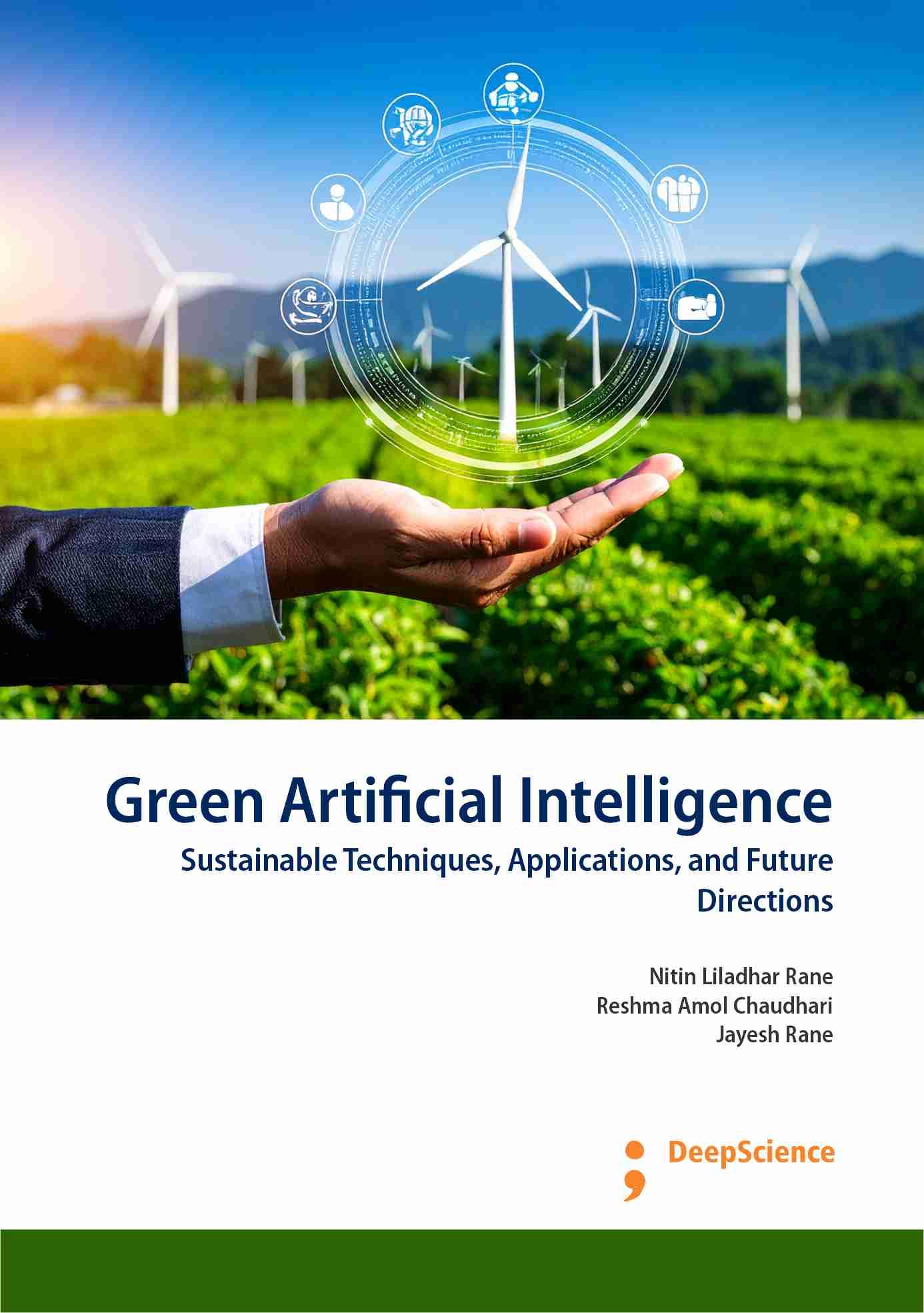
Green Artificial Intelligence: Sustainable Techniques, Applications, and Future Directions
##plugins.pubIds.doi.readerDisplayName##
https://doi.org/10.70593/978-93-7185-399-6
Keywords:
Machine Learning, Deep Learning, Artificial Intelligence, Environmental Impact, Climate Change, Green Computing, Energy EfficiencySynopsis
The recent years have seen the artificial intelligence increase exponentially, which has fundamentally changed all human activities, including healthcare and transportation, education, and environmental management. However, in this critical time in technological development, we have to face a very inconvenient reality, and it is the same systems that we invent to address the most crucial problems humanity has ever faced that are now playing a major role in one of the most urgent disasters humanity has ever experienced climate change. This book is a result of the desperate necessity to balance the radical potential of artificial intelligence with the necessity to take care of the planet in an environmentally responsible manner so that we could leave it to our future generations. The genesis of this piece is based on a problematic observation that the AI community has accomplished much in developing model powers and broadening their uses, yet there has been comparatively little focus done regarding the environmental impact of the successes. The process of training one large language model can be as energy-intensive as hundreds of homes per year, and production of state-of-the-art AI systems amounts to carbon emissions similar to transcontinental travel. The realization of the sobering fact requires a radical change in the conceptualization, development, and implementation of artificial intelligence systems.
This multifaceted book is the collection of the most innovative studies, effective practices, and applications in the real world that is going to lead to the really sustainable artificial intelligence. In nine carefully developed chapters, we stroll through the diverse environment of our world of energy-saving machine learning comprising algorithmic optimizations and green machine learning architectures, distributed machine learning frameworks and explainable AI models. To a certain extent, every chapter is a part of a bigger puzzle, which is how to leverage the transformative nature of AI and reduce its environmental impact. Our exploration starts with the study of energy efficient machine learning algorithms, where we discover methods to optimize them and minimize their computational and other costly needs by up to 90 per cent and preserve their performance. Then we explore the carbon footprint of deep learning systems, introducing novel green computing approaches that refute the classic trade-offs between model complexity and environmental sustainability. The discussion of federated learning and distributed AI models demonstrates that not only privacy and security improving, but also, the decentralized processes can lower the costs of the energy used to process data in a centralized data processing domain significantly.
In addition to the technical background, this book is concerned with the transformative uses of sustainable AI in different spheres. We show how AI can save energy by enabling clean urban infrastructure to coexist with environmental care, such as precision agriculture, which maximizes efficiency in resource use by developing a broader global economy, and smart cities that ensure the sustainability of human activities. The correlation between the renewable energy prediction, the circular economy, and the manufacturing with the help of the blockchain is an example of how AI may not only reduce its impact on the environment but also be an active participant in the comprehensive processes of climate change mitigation.
One of the peculiarities of this work is its adherence to the intention to cover the gap between theoretical developments and practice. Not only conceptual frameworks and algorithmic innovations but also metrics of performance verification, the issues of deployment and the real-world cases are given in each chapter. We also acknowledge that the way to sustainable AI is not necessarily a technological one, it involves cross-disciplinary cooperation, policy innovation, and complete re-evaluation of the principles of measuring success in the development of artificial intelligence. The target group of this book includes a very wide range of stakeholders in the sphere of the AI ecosystem. Investigators will get detailed reviews of latest methods and reveal of an open research problem. Engineers and practitioners will find workable ways of introducing energy saving measures in their systems. Business leaders and policy makers will have insight as to how sustainable AI adoption would impact economically and environmentally. The systematization of the approach to the presentation of ideas, starting with the basic ones, up to an in-depth application, will be beneficial to students and educators.
In the 21 st century, the decisions we make regarding artificial intelligence development will have an echo effect on the generations to come. Climate crisis is an urgent demand, and the potential of AI as a transformative technology is unparalleled in the opportunities it provides to solve the problems of the environment on mass scale. The book posits that the two imperatives position do not conflict with each other, but instead complement one another, i.e. the quest to develop energy-efficient and sustainable AI will produce less harmful environmental impact, on the contrary will enhance innovation and accessibility, and will result in more resilient and adaptive systems. The studies that are exhibited on these pages reflect the collective will of the planet to develop AI in a responsible way. We recognize the individuals who initially raised the issue of the environmental cost of AI, the scientists who were able to devise the optimization methods that have allowed sustainable AI to become practical, and the practitioners that are currently realizing them in real systems. Their shoulders bear this work and he/she wants to hasten the process of changing the world where the environmental sustainability will be enhanced by artificial intelligence, instead of it being a source of environmental destruction.
The future of the vision expressed in this book goes farther than increased efficiency in the use of energy. We see a paradigm shift when sustainability is involved in the first-order design when developing AI is considered with equal importance as focus to energy consumption as accuracy regarding the performance of the AI, and when the AI community acknowledges the possibility to be caretakers of not only the advancement of technologies but also the environment. Our presented roadmap is both ambitious and realistic, which will need the involvement of all three academia, industry, and the government. Going green is not just an optimization issue on AI, but a necessity that will become the heritage of our own generation. We have also taken it as our hope that the book can be a reference and a call to action as it can encourage readers to play a role in developing the AI systems that will unlock the human potential without harming the natural world to the bequest of the upcoming generations.
References
[1] Ali O, Abdelbaki W, Shrestha A, Elbasi E, Alryalat MA, Dwivedi YK. A systematic literature review of artificial intelligence in the healthcare sector: Benefits, challenges, methodologies, and functionalities. Journal of Innovation & Knowledge. 2023 Jan 1;8(1):100333.
[2] Zhang K, Yang X, Wang Y, Yu Y, Huang N, Li G, Li X, Wu JC, Yang S. Artificial intelligence in drug development. Nature medicine. 2025 Jan;31(1):45-59.
[3] Tan X, Cheng G, Ling MH. Artificial intelligence in teaching and teacher professional development: A systematic review. Computers and Education: Artificial Intelligence. 2025 Jun 1;8:100355.
[4] Jain S, Sholapurapu PK, Sharma B, Nagar M, Bhatt N, Swaroopa N. Hybrid Encryption Approach for Securing Educational Data Using Attribute-Based Methods. In2025 4th OPJU International Technology Conference (OTCON) on Smart Computing for Innovation and Advancement in Industry 5.0 2025 Apr 9 (pp. 1-6). IEEE.
[5] Hanna MG, Pantanowitz L, Jackson B, Palmer O, Visweswaran S, Pantanowitz J, Deebajah M, Rashidi HH. Ethical and bias considerations in artificial intelligence/machine learning. Modern Pathology. 2025 Mar 1;38(3):100686.
[6] Han H, Shiwakoti RK, Jarvis R, Mordi C, Botchie D. Accounting and auditing with blockchain technology and artificial Intelligence: A literature review. International Journal of Accounting Information Systems. 2023 Mar 1;48:100598.
[7] Kumar Y, Koul A, Singla R, Ijaz MF. Artificial intelligence in disease diagnosis: a systematic literature review, synthesizing framework and future research agenda. Journal of ambient intelligence and humanized computing. 2023 Jul;14(7):8459-86.
[8] Mannuru NR, Shahriar S, Teel ZA, Wang T, Lund BD, Tijani S, Pohboon CO, Agbaji D, Alhassan J, Galley J, Kousari R. Artificial intelligence in developing countries: The impact of generative artificial intelligence (AI) technologies for development. Information development. 2025 Sep;41(3):1036-54.
[9] Tu T, Schaekermann M, Palepu A, Saab K, Freyberg J, Tanno R, Wang A, Li B, Amin M, Cheng Y, Vedadi E. Towards conversational diagnostic artificial intelligence. Nature. 2025 Apr 9:1-9.
[10] Ozmen Garibay O, Winslow B, Andolina S, Antona M, Bodenschatz A, Coursaris C, Falco G, Fiore SM, Garibay I, Grieman K, Havens JC. Six human-centered artificial intelligence grand challenges. International Journal of Human–Computer Interaction. 2023 Feb 7;39(3):391-437.
[11] Kasireddy LC, Bhupathi HP, Shrivastava R, Sholapurapu PK, Bhatt N. Intelligent Feature Selection Model using Artificial Neural Networks for Independent Cyberattack Classification. In2025 2nd International Conference On Multidisciplinary Research and Innovations in Engineering (MRIE) 2025 Jul 30 (pp. 572-576). IEEE.
[12] Gong Q, Fan D, Bartram T. Integrating artificial intelligence and human resource management: a review and future research agenda. The International Journal of Human Resource Management. 2025 Jan 2;36(1):103-41.
[13] Zulaikha S, Mohamed H, Kurniawati M, Rusgianto S, Rusmita SA. Customer predictive analytics using artificial intelligence. The Singapore Economic Review. 2025 Jun 6;70(04):1009-20.
[14] Khan SA, Sheikh AA, Shamsi IR, Yu Z. The implications of artificial intelligence for small and medium-sized enterprises’ sustainable development in the areas of blockchain technology, supply chain resilience, and closed-loop supply chains. Sustainability. 2025 Jan 4;17(1):334.
Downloads
Published
10 July 2025
Copyright (c) 2025 Nitin Liladhar Rane, Reshma Amol Chaudhari, Jayesh Rane
Details about the available publication format: E-Book
E-Book
ISBN-13 (15)
978-93-7185-399-6
Details about the available publication format: Book (Paperback)
Book (Paperback)
ISBN-13 (15)
978-93-7185-931-8
How to Cite
Rane, N. L. ., Chaudhari, R. A. ., & Rane, J. . (2025). Green Artificial Intelligence: Sustainable Techniques, Applications, and Future Directions. Deep Science Publishing. https://doi.org/10.70593/978-93-7185-399-6
Download Citation








 WhatsApp +91 7977171947