
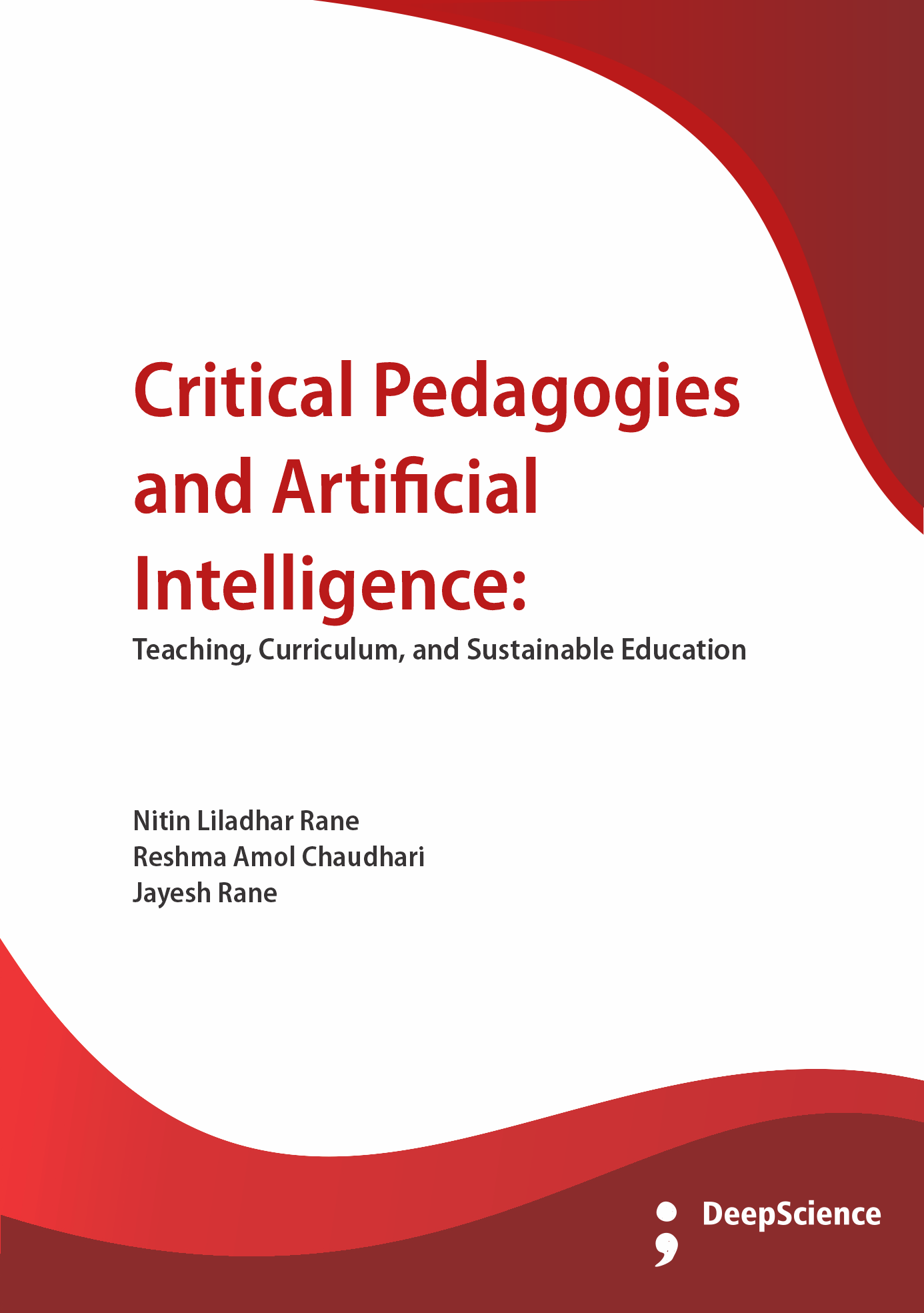
Critical Pedagogies and Artificial Intelligence: Teaching, Curriculum, and Sustainable Education
##plugins.pubIds.doi.readerDisplayName##
https://doi.org/10.70593/978-93-7185-727-7
Keywords:
Artificial Intelligence, Education, Sustainable Development, Machine Learning, Deep Learning, Personnel Training, Curricula DesignSynopsis
Over the past few years, artificial intelligence has emerged at an extremely high pace, and it has transformed all the fields of knowledge that are being digitalized. Education - traditionally the foundation block of progress and development in society, is now experiencing one of its most dramatic paradigm shifts ever. Machine learning, deep learning, data-driven pedagogies, and intelligent learning environments have led to the new area, where the personalization, the sustainability, and the globality converge. It is against this critical backdrop that this book has come into being, where the author has provided a holistic and evidence-based discussion of how AI can transform the education sector in line with the Sustainable Development Goals (SDGs) and the changing demands of the higher learning institutions. The chapters aggregated in this book indicate an interdisciplinary and futuristic attempt to curb both the possibilities as the challenges involved in integrating AI into modern curricula. A survey of intelligent tutoring systems and ChatGPT-mediated discourse analysis, an IoT-enabled learning ecosystem, and adaptive sustainability-oriented frameworks are some of the approaches to the growth of teaching, assessment, and design educational processes, which each of the chapters presents a distinct perspective on how artificial intelligence can facilitate the design, teaching, and assessment process. They all indicate that AI is not a frivolous technology; it is an extraordinary disruptor that can substantially change the kind of knowledge learner acquire, the types of learning experiences that teachers create, and how schools can become innovative, fair, and be aware of the world.
Identifying AI-enhanced education as more than an efficiency mechanism and a philosophical and pedagogical change is one of the recurrent themes in this book. Educators are able to operate within the intelligent systems instead of the traditional sporadic one-size-fits-all teaching. They facilitate the adaptive learning course which reacts dynamically to student performance, learning expectations, cultural orientations as well as emotional prompts. In conjunction with sustainability-focused curricula, the capabilities have a direct contribution to the development of competencies of environmental stewardship and social responsibility, systems thinking, and ethical technological citizenship. The other value that can be made in this book is its attention to accessibility and inclusion. As the chapters demonstrate, multilingual translation systems, the use of assistive technologies based on the principles of machine learning, and AI-mediated collaborative tools can overcome the obstacles that have previously alienated marginalized learners. With AI, diverse learning environments can be created by providing culturally responsive material, custom guidance, and instant feedback, which represent the crucial aspect of the SDG 4: Quality Education goal.
Meanwhile, this book cannot be seen as romanticizing technology. Numerous of its chapters contain critical analysis of the privacy of data, bias in algorithms, quality assurance, ethical design, and the possibility to increase disparities when there is no proper governance of AI systems use. These evaluations support the concept that the technological innovation should be thoroughly human-centered. Artificial intelligence must not exist on the expense of human training, but enhance it by adding complexity and multiplying the abilities of an instructor. Between the excitement and the caution these chapters bring to educational practice are the practical information about the formation of responsible solutions in AI that would respect the principles of academic integrity, autonomy as a learner, and social justice. Another main line running through the text is the issue of sustainability. Regardless of it being resource optimization, literature our curriculum design, or mass education training workforce, the book places AI within the context of the overall task of future education preparing students to face the complexity of an ever-evolving world. The systems and models mentioned here are not only technologically advancing but are also environmental friendly, with the aim of minimizing wastages, enhancing scalability and developing long-term flexibility within the various institutions of learning.
Methodological connectivity is also abundant in this volume as it relies heavily on the systematic literature reviews, empirical case studies, conceptual frameworks, and the cross-disciplinary approaches to research. The application of strict PRISMA-based methodologies shows the commitment of the authors to the task of basing each observation on viable evidence. Consequently, the readers will discover a healthy dose of theoretical richness, analytical acumen and practical advice. However, the book will appeal to a broad audience: scholars attempting to learn more about AI-enhanced pedagogy, educators interested in adopting sophisticated technologies in teaching, policymakers interested in the issues of equity and governance, and technologists interested in figuring out how to develop systems that will make a meaningful contribution to sustainable development. It is also addressed to the students- the very people that will contribute to the future of the learning with the use of AI. Since the development of artificial intelligence is a mighty beast that should not be underestimated, the methods of comprehending education should also evolve. These chapters are thought provoking, reflective and open to the imagination of the future where technology and humanity can be seen collaborating to create more resilient, inclusive and sustainable learning systems. I sincerely hope that the book will be read and viewed as the source of fresh research, inter-sector cooperation, and power of readers to generate the transformative potential of AI, not only to innovate education, but also to improve the lives of people everywhere.
References
Yim IH, Su J. Artificial intelligence (AI) learning tools in K-12 education: A scoping review. Journal of Computers in Education. 2025 Mar;12(1):93-131.
Samala AD, Rawas S, Wang T, Reed JM, Kim J, Howard NJ, Ertz M. Unveiling the landscape of generative artificial intelligence in education: a comprehensive taxonomy of applications, challenges, and future prospects. Education and Information Technologies. 2025 Feb;30(3):3239-78.
Alwaqdani M. Investigating teachers’ perceptions of artificial intelligence tools in education: potential and difficulties. Education and Information Technologies. 2025 Feb;30(3):2737-55.
Cukurova M. The interplay of learning, analytics and artificial intelligence in education: A vision for hybrid intelligence. British Journal of Educational Technology. 2025 Mar;56(2):469-88.
Tlili A, Saqer K, Salha S, Huang R. Investigating the effect of artificial intelligence in education (AIEd) on learning achievement: A meta-analysis and research synthesis. Information Development. 2025 Jan 17:02666669241304407.
Zhao Y. Artificial intelligence and education: End the grammar of schooling. ECNU Review of Education. 2025 Mar;8(1):3-20.
Charow R, Jeyakumar T, Younus S, Dolatabadi E, Salhia M, Al-Mouaswas D, Anderson M, Balakumar S, Clare M, Dhalla A, Gillan C. Artificial intelligence education programs for health care professionals: scoping review. JMIR Medical Education. 2021 Dec 13;7(4):e31043.
Park W, Kwon H. Implementing artificial intelligence education for middle school technology education in Republic of Korea. International journal of technology and design education. 2024 Mar;34(1):109-35.
Tedre M, Toivonen T, Kahila J, Vartiainen H, Valtonen T, Jormanainen I, Pears A. Teaching machine learning in K–12 classroom: Pedagogical and technological trajectories for artificial intelligence education. IEEE access. 2021 Jul 19;9:110558-72.
Polak S, Schiavo G, Zancanaro M. Teachers’ perspective on artificial intelligence education: An initial investigation. InCHI conference on human factors in computing systems extended abstracts 2022 Apr 27 (pp. 1-7).
Lampropoulos G. Combining artificial intelligence with augmented reality and virtual reality in education: Current trends and future perspectives. Multimodal Technologies and Interaction. 2025 Jan 28;9(2):11.
Mumtaz S, Carmichael J, Weiss M, Nimon-Peters A. Ethical use of artificial intelligence based tools in higher education: are future business leaders ready?. Education and Information Technologies. 2025 Apr;30(6):7293-319.
Feigerlova E, Hani H, Hothersall-Davies E. A systematic review of the impact of artificial intelligence on educational outcomes in health professions education. BMC Medical Education. 2025 Jan 27;25(1):129.
McDonald N, Johri A, Ali A, Collier AH. Generative artificial intelligence in higher education: Evidence from an analysis of institutional policies and guidelines. Computers in Human Behavior: Artificial Humans. 2025 Mar 1;3:100121.
Topali P, Ortega-Arranz A, Rodríguez-Triana MJ, Er E, Khalil M, Akçapınar G. Designing human-centered learning analytics and artificial intelligence in education solutions: a systematic literature review. Behaviour & Information Technology. 2025 Mar 16;44(5):1071-98.
Huang X. Aims for cultivating students’ key competencies based on artificial intelligence education in China. Education and Information Technologies. 2021 Sep;26(5):5127-47.
Lampou R. The integration of artificial intelligence in education: Opportunities and challenges. Review of Artificial Intelligence in Education. 2023 Aug 18;4:e15-.
Pham ST, Sampson PM. The development of artificial intelligence in education: A review in context. Journal of Computer Assisted Learning. 2022 Oct;38(5):1408-21.
Chen X, Zou D, Xie H, Cheng G, Liu C. Two decades of artificial intelligence in education. Educational Technology & Society. 2022 Jan 1;25(1):28-47.
Ouyang F, Jiao P. Artificial intelligence in education: The three paradigms. Computers and Education: Artificial Intelligence. 2021 Jan 1;2:100020.
Lameras P, Arnab S. Power to the teachers: an exploratory review on artificial intelligence in education. Information. 2021 Dec 29;13(1):14.
Zhai X, Chu X, Chai CS, Jong MS, Istenic A, Spector M, Liu JB, Yuan J, Li Y. A Review of Artificial Intelligence (AI) in Education from 2010 to 2020. Complexity. 2021;2021(1):8812542.
Stolpe K, Hallström J. Artificial intelligence literacy for technology education. Computers and Education Open. 2024 Jun 1;6:100159.
Huang L. Ethics of artificial intelligence in education: Student privacy and data protection. Science Insights Education Frontiers. 2023 Jun 30;16(2):2577-87.
Kamalov F, Santandreu Calonge D, Gurrib I. New era of artificial intelligence in education: Towards a sustainable multifaceted revolution. Sustainability. 2023 Aug 16;15(16):12451.
Huang J, Saleh S, Liu Y. A review on artificial intelligence in education. Academic Journal of Interdisciplinary Studies. 2021 May;10(3).
Su J, Ng DT, Chu SK. Artificial intelligence (AI) literacy in early childhood education: The challenges and opportunities. Computers and Education: Artificial Intelligence. 2023 Jan 1;4:100124.
Idroes GM, Noviandy TR, Maulana A, Irvanizam I, Jalil Z, Lensoni L, Lala A, Abas AH, Tallei TE, Idroes R. Student perspectives on the role of artificial intelligence in education: A survey-based analysis. Journal of Educational Management and Learning. 2023 Jul 24;1(1):8-15.
Tapalova O, Zhiyenbayeva N. Artificial intelligence in education: AIEd for personalised learning pathways. Electronic Journal of e-Learning. 2022;20(5):639-53.
Alam A. Possibilities and apprehensions in the landscape of artificial intelligence in education. In2021 International conference on computational intelligence and computing applications (ICCICA) 2021 Nov 26 (pp. 1-8). IEEE.
Downloads
Published
10 July 2025
Copyright (c) 2025 Nitin Liladhar Rane, Reshma Amol Chaudhari, Jayesh Rane
Details about the available publication format: E-Book
E-Book
ISBN-13 (15)
978-93-7185-727-7
Details about the available publication format: Book (Paperback)
Book (Paperback)
ISBN-13 (15)
978-93-7185-099-5
How to Cite
Rane, N. L. ., Chaudhari, R. A. ., & Rane, J. . (2025). Critical Pedagogies and Artificial Intelligence: Teaching, Curriculum, and Sustainable Education. Deep Science Publishing. https://doi.org/10.70593/978-93-7185-727-7
Download Citation





 WhatsApp +91 7977171947