

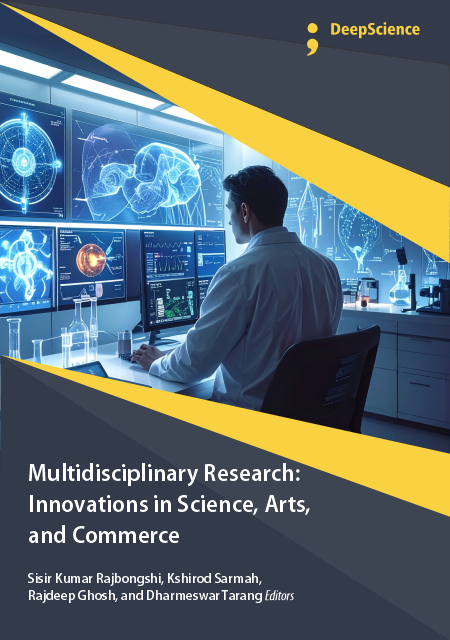
Multidisciplinary Research: Innovations in Science, Arts, and Commerce
##plugins.pubIds.doi.readerDisplayName##
https://doi.org/10.70593/978-93-7185-737-6
Keywords:
Artificial Intelligence, Prompt Engineering, Pedagogy, Internet of Things, Cloud Computing, Sustainable Development Goals , Circular EconomySynopsis
In the department of computer science, we have a good environment of research, innovation as we have a full man power. Since the establishment of Department of Computer Science, PDUAM Amjonga in 2017, our department has been trying to conduct seminars, conferences lecture series, awareness program etc. Since then the department is trying to provide quality education focusing in the academic side as well as in innovative side also. One of the visions of Computer Science department, PDUAM Amjonga was to do some good quality research oriented works for better society. As a result of this thinking this edited book “Multidisciplinary Research: Innovations in Science, Arts and Commerce” is going to published.
In this edition, we have received more than 80 articles. Out of them we have selected 41 articles for publication. The contributions have been divided into Artificial Intelligence and ICT, Mathematics, Physical and Life Sciences, Commerce and Economics, Social Sciences, and Arts and Culture. This kind of interdisciplinary approach is the need of the time.
The book tries to inspire researches with innovations in young minds which can become accessible to students, academicians, researchers and professionals.
We want to thank our respected advisors -Prof. Anjana Kakoti Mahanta (Department of Computer Science, Gauhati University), Prof. Helen K Saikia (Department of Mathematics, Gauhati University), and Prof. Utpal Bhattacharjee (Department of Computer Science & Engineering, Rajiv Gandhi University) — for their valuable guidance and encouragement since one year and also throughout the preparation of this book. Their expertise, experience and knowledge will enrich the quality of our book.
We would like to acknowledge all the contributors for their articles, and also the reviewers for their valuable comments and feedback, all the well wishers of PDUAM, Amjonga, and Deep Science Publishing for their support. At the end we would like to thank the authority, Pandit Deendayal Upadhyaya Adarsha Mahavidyalaya, Amjonga, for hosting and supporting this initiative.
We believe this publication will inspire future scholars to engage in multidisciplinary research and contribute to a knowledge-driven society.
References
Abou Seif, H. S. (2014b). Ameliorative effect of parsley oil (Petroselinum crispum) against alcohol-induced hepatotoxicity and oxidative stress. Medical Research Journal, 13(2), 100–107.
Abou Seif, H. S. (2014a). Ameliorative effect of pumpkin oil (Cucurbita pepo L.) against alcohol-induced hepatotoxicity and oxidative stress in albino rats. Beni-Suef University Journal of Basic and Applied Sciences, 3(3), 178–185.
Abou Seif, H. S. (2016). Physiological changes due to hepatotoxicity and the protective role of some medicinal plants. Beni-Suef University Journal of Basic and Applied Sciences, 5(2), 134–146.
Abu, M., Nyeem, B., Alam, K., & Hossain, A. (2017). A review of evidence-based hepatoprotective selected medicinal plants used in Bangladeshi traditional medicine. Bangladeshi Traditional Medicine, 2(1), 13–17.
Aeschbach, R., Loliger, J., Scott, B. C., Murcia, A., Butler, J., Halliwell, B., & et al. (1994). Antioxidant actions of thymol, carvacrol, 6-gingerol, zingerone and hydroxytyrosol. Food and Chemical Toxicology, 32(1), 31–36.
Alobaidi, S. (2024). Renal health benefits and therapeutic effects of parsley (Petroselinum crispum): A review. Frontiers in Medicine, 11, 1494740.
Al-Zuhair, H., Abdel-Fattah, A. A., & El-Sayed, M. I. (2000). Pumpkin-seed oil modulates the effect of felodipine and captopril in spontaneously hypertensive rats. Pharmacological Research, 41(5), 555–563.
Au, J. S., Navarro, V. J., & Rossi, S. (2011). Drug-induced liver injury – Its pathophysiology and evolving diagnostic tools. Alimentary Pharmacology & Therapeutics, 34(1), 11–20.
Awang, D. V. C. (1992). Ginger. Canadian Pharmaceutical Journal, 125(6), 309–311.
Downloads
Published
24 September 2025
Copyright (c) 2025 Sisir Kumar Rajbongshi, Kshirod Sarmah, Rajdeep Ghosh, Dharmeswar Tarang
Details about the available publication format: E-Book
E-Book
ISBN-13 (15)
978-93-7185-737-6
Details about the available publication format: Book (Paperback)
Book (Paperback)
ISBN-13 (15)
978-93-7185-157-2
How to Cite
Rajbongshi, S. K. ., Sarmah, K. ., Ghosh, R. ., & Tarang, D. . (Eds.). (2025). Multidisciplinary Research: Innovations in Science, Arts, and Commerce. Deep Science Publishing. https://doi.org/10.70593/978-93-7185-737-6
Download Citation





 WhatsApp +91 7977171947